AI Document Analysis for Regulated Industries: A Production Architecture Guide
· Tampa Dynamics
Document analysis is one of the highest-value uses of AI in regulated industries — and one of the most misunderstood. Teams arrive expecting software that “reads documents and answers questions.” What they get, if the system isn’t designed carefully, is a pipeline that looks great in demos and fails in production on exactly the edge cases that matter.
This guide covers what document analysis involves at the system level: where the real complexity lives, and the architecture decisions that determine whether AI-generated answers about contracts, clinical records, and regulatory documents hold up under audit.
What “document analysis” actually means
“Document analysis” names a family of distinct tasks, and conflating them is where most projects go wrong.
- Extraction pulls structured data out of unstructured text — dates, parties, dollar amounts, clause identifiers, diagnosis codes. A document goes in; a structured record comes out.
- Classification assigns a document or a section to a category — contract type, claim status, priority.
- Understanding answers questions about content, summarizes, finds inconsistencies, and reasons across documents. This is the one most teams actually want, and the one where hallucination risk is highest.
These tasks fail in different ways and carry different costs. Before you design anything, pin down which of them your system actually needs and how accurate each one has to be for the workflow to be safe.
Rules or models: pick per task, not per project
The default assumption in 2026 is that a language model is the right tool for every document task. It’s often wrong. A prior-authorization form that always puts the diagnosis code in the same place doesn’t need a language model — a deterministic parser is faster, cheaper, more accurate on that template, and far easier to defend in an audit.
- Rule-based extraction wins when the document structure is consistent and the fields are well-defined — and when an auditor needs to be able to inspect the logic.
- Models earn their place when structure varies from document to document, or when the task requires actually understanding the language instead of matching patterns in it.
The architecture that holds up in practice is layered. Deterministic parsing handles the predictable fields, smaller models handle classification, and the large models are saved for the understanding work nothing else can do — the least deterministic component gets used only where it’s genuinely necessary.
OCR sets your ceiling
Modern frontier models can ingest PDFs and scanned images directly, and for low-volume work that’s often enough. High-volume production pipelines still convert documents to text first, because the explicit step buys control: per-field confidence scores, predictable behavior, manageable cost, and a record of exactly what the model was given. Either way, the parsing layer — dedicated OCR or a vision model — sets the ceiling on everything downstream. Healthcare and legal work runs on scanned paper (faxed records, intake forms, historical contracts, court filings), and a model cannot reason correctly about text the parsing pass already garbled.
- Evaluate parsing options — dedicated OCR engines and vision-model extraction — on your actual document corpus, not published benchmarks; accuracy profiles differ sharply by document type.
- Preprocess before OCR: deskewing, denoising, and contrast normalization materially improve output.
- Tables, checkboxes, and multi-column layouts need layout-aware extraction; general OCR reads linearly and destroys the relationships between fields.
- Expose per-field confidence scores and route low-confidence extractions to human review instead of passing them silently downstream.
After OCR comes normalization and — for retrieval systems — chunking. Chunks that are too small lose context; chunks that are too large dilute relevance and blow out context windows. Match the strategy to how the documents are actually built — paragraph-level chunks for narrative text, section-level for structured reports and anything with a real heading hierarchy.
RAG architecture for document Q&A
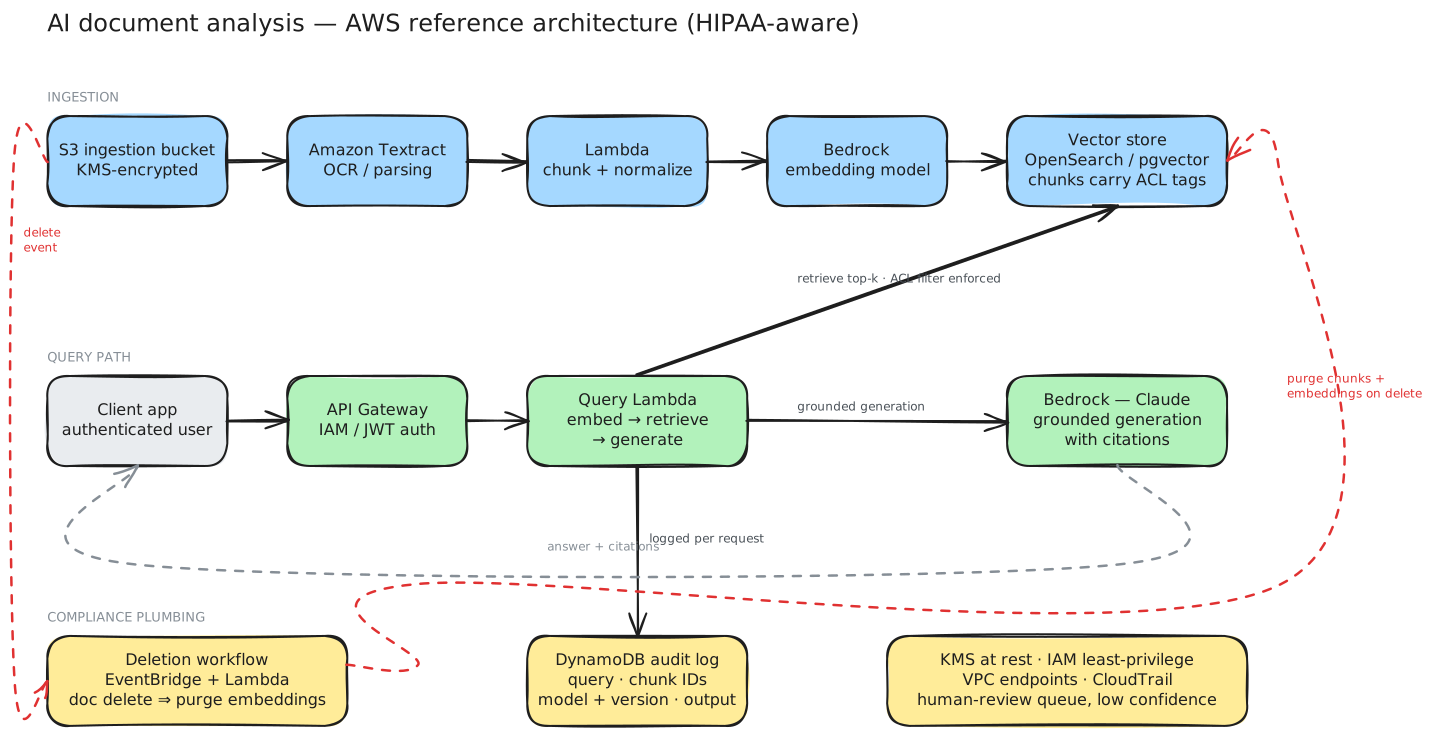
Retrieval-augmented generation is the standard production architecture for document question-answering. Long-context models can swallow a whole document at once, and for single-document questions that can be the simpler choice — but across a corpus of thousands of documents, retrieval is still the architecture. Documents are preprocessed, chunked, embedded, and stored in a vector database at ingestion; at query time the question is embedded, the closest chunks are retrieved, and the model answers grounded in only that context.
Two upgrades matter in production. Hybrid search: pure vector similarity misses exact matches, proper nouns, and identifiers, so production systems pair it with keyword search. Re-ranking: a second pass that scores each retrieved chunk against the query with more precision than embedding similarity, trading latency for accuracy — in regulated workflows, a trade usually worth making.
Attribution is not optional. Every answer needs to be traceable to its source passages — citations in the interface so a reviewer can check claims against the documents, and a log of which chunks were retrieved and which shaped the answer. A system that produces correct-looking answers without provenance can’t be used for legal review or clinical decisions, no matter how good the answers are.
This is the architecture behind a deposition-analysis system we built for a legal-tech platform: retrieval over thousands of pages of transcripts, one model answering questions in context, a second reading for contradictions between testimony. It went from design to running on real caseloads in three months.
What this looks like by industry
Legal. Clause extraction and classification across large contract sets, obligation and deadline extraction, inconsistency detection, and due-diligence Q&A across a data room. Accuracy requirements are extreme — a missed limitation-of-liability clause is real liability — so the AI’s job is to triage and surface, never to conclude. Privilege shapes the architecture too: a document from one client matter must never surface in a query about another, which means tenant isolation enforced inside the vector store itself.
Healthcare and pharma. Prior-authorization support (matching clinical criteria in patient records against payer requirements), clinical documentation, referral and discharge processing, and pharma document management — batch records, submissions, SOPs. HIPAA applies to the entire pipeline: access-controlled storage, audit logging on every retrieval, BAAs with every vendor whose infrastructure touches PHI, and de-identification before anything reaches a vendor that can’t sign one.
Financial services. Pulling figures, risk factors, and forward-looking statements from filings; identifying covenant terms and trigger conditions across credit agreements; classifying and routing regulatory correspondence. The theme repeats: a decision supported by AI analysis of regulatory documents has to be able to show its sources.
Hallucination is a design problem
A model generating plausible, wrong content is the central reliability problem in document analysis. In a regulated workflow, a hallucinated clause interpretation or a fabricated clinical detail causes direct harm. Mitigation is architectural — in order of effectiveness:
- Constrain the task. Extraction against an explicit output schema hallucinates far less than open-ended summarization. Decompose complex Q&A into constrained sub-tasks wherever possible.
- Ground the generation. Instruct the model to answer only from the provided context and to say when the context is insufficient — then test that it actually obeys on your documents.
- Verify after generation. Check that specific claims in the output appear in the source chunks. This catches fabrications that survive careful prompting.
- Keep humans at the consequence points. No strategy eliminates hallucination. Where an error is expensive — a contract interpretation about to be executed, a clinical entry that affects care — human review belongs in the workflow design itself, as a required step.
Compliance: retention, access, audit
- Retention. Define retention periods by document type and regulation — and make deletion cover derived data. Deleting a source document does not delete its embeddings from the vector store, and it’s an easy step to miss.
- Access control at the retrieval layer. Tag chunks with access metadata at indexing time and filter retrieval results by the requester’s rights before anything reaches the model. Storage-layer permissions alone cannot stop a query from surfacing documents the user shouldn’t see.
- Audit logging. Record the query, the retrieved document identifiers, the model and version, and the generated output for every request. That log is your evidence the system behaved correctly when an output is challenged.
Human review that isn’t theater
AI changes what human reviewers spend time on — less mechanical scanning, more judgment. The patterns that make that real:
- Triage: the system orders documents by risk or urgency; humans review in that order instead of sequentially.
- Flagging, not concluding: the AI surfaces provisions that warrant attention; a person evaluates them.
- Confidence-gated automation: high-confidence extractions proceed automatically, low-confidence ones queue for review, and the threshold is calibrated to the cost of an error.
- Active review interfaces: present output as an annotated draft a reviewer accepts, rejects, or edits — item by item. A system that makes rubber-stamping easy is not a safe human-in-the-loop system, whatever the diagram says.
This is an engineering problem
The AI components — models, embeddings, vector stores — are available to everyone. What separates the systems that survive audit is engineering: explicit accuracy controls, attribution built in from the start, access control enforced where retrieval happens, and review interfaces that reviewers actually use. Those decisions get made at design time, which is where the expensive mistakes happen — before anyone has written a line of code.
Evaluating or building a document-analysis system for legal, healthcare, or financial workflows? A Clarity Assessment is a structured way to surface the decisions that will be expensive to change later — before they’re made. Our method starts with the problem, not the model.